Hidden Hollow Farm sits embedded in the historic landscape of Warren County, New Jersey. The story of his land stretches far back beyond modern boundaries, rooted in centuries of human stewardship, colonial craftsmanship, and a deep family commitment to agricultural excellence.
Centuries of Colonial and Indigenous Heritage
The land comprising Hidden Hollow Farm carries a documented legacy dating to ca. 1790, with land deeds recording private ownership continuously through to the present day. Long before European settlement, the region was inhabited by the Lenape people, whose respect for the soil, waters, and forests established a deep spiritual relationship with the environment. Artifacts unearthed across our pastures, including a hand carved stone pestle used to grind grain, serve as quiet reminders of those who walked these fields centuries ago.
Located at the top of a mountain four miles above Oxford, New Jersey, the farm is tied to early American industrial history. Oxford is home to the Oxford Blast Furnace, constructed in 1741 and listed on the National Register of Historic Places. During the 18th century, hardwood forests across this region were managed to support iron production, shaping the physical contours of the surrounding valley.
The Historic Structures and Schoolhouse Park
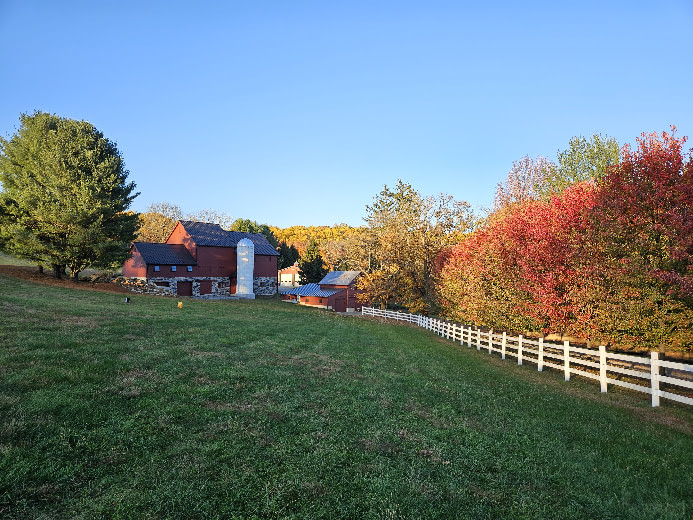
The earliest permanent structure on the farm was a single room stone house with a large hearth dating to the late 18th century. In the mid-19th century, the then-owners erected a timber bank barn and equipment shed constructed with hand hewn beams. The farm owners donated a small parcel of land to construct a single room stone schoolhouse which served the local mountain community through the 1880s.Today, the stone foundation of the schoolhouse has been carefully cleared, preserved, and planted with native trees and wildflowers, creating a peaceful historical park on the property.
Many changes and additions were made to the house and farm buildings over the ensuing years, and weather and wood-eating insects undermined their structural integrity. Between 2018 and 2024, the primary farm structures were thoughtfully rebuilt to address contemporary needs while largely preserving their earlier aesthetic and footprint.
A Multi Generational Family Legacy
The modern chapter of Hidden Hollow Farm began in the 1950s when Kathleen’s parents acquired the property. Both native New Jerseyans, her father graduated from the agricultural school at Rutgers University and served in the army during the Korean War, while her mother graduated from Douglass College at Rutgers with a degree in studio art. Seeking a meaningful place to raise a family, they fell in love with the setting despite the rundown condition of the original buildings.
After briefly trying chicken farming, they transitioned to raising beef cattle, including Herefords and Black Angus. To sustain the farm, Kathleen’s father worked full time as a local science teacher, later becoming a vice principal and K-4 elementary school principal. Her mother went back to college to earn a degree in Landscape Architecture. Her father’s deep knowledge of agriculture and natural science, combined with her mother’s artistic design background and knowledge of plants, created an environment where hard work, land care, and aesthetic discipline were daily values.
All 6 children, 5 girls and 1 boy, worked on the farm from an early age. Daily responsibilities included picking millions of rocks from the fields, hauling hay, repairing fences, feeding livestock, and tending a large family garden. Without expensive machinery or outside labor, the family built a modest operation where every family member contributed to the daily rhythm of farm life.
Farmland Preservation and Long-Term Stewardship
Following her father’s passing in 1988, Kathleen’s mother continued to operate the farm, establishing a Christmas tree program across the sub-par fields while maintaining the hay fields and selling hay. In 2006, after several years of application, the farm was officially accepted into the New Jersey Farmland Preservation program.
“Our connection to this land is guided by a profound respect for those who cared for it before us. The stone walls, ancient trees, and soil history remind us that we are stewards for a brief moment in time.”
— Kathleen Enz Finken
This critical decision preserved the property’s agricultural rights in perpetuity, ensuring that its green space, forests, and pastures can never be converted into commercial real estate or residential housing. In the nation’s most densely populated state, Hidden Hollow Farm stands as a permanently protected sanctuary for agriculture, land conservation, and elite Red Angus cattle genetics.